
April is Arab American Heritage Month, which is a time to celebrate and honor contributions made by members of the Arab American community. This interview is brought to you by Welcome to America team members Niki G., Librarian at Martha Cooper Library and Talya A., Librarian at Kirk Bear-Canyon Library. Pima County Public Library recognizes, welcomes, and celebrates immigrants for their contributions to our shared success. The library provides free and equitable access to programs and services across our organization and the community.
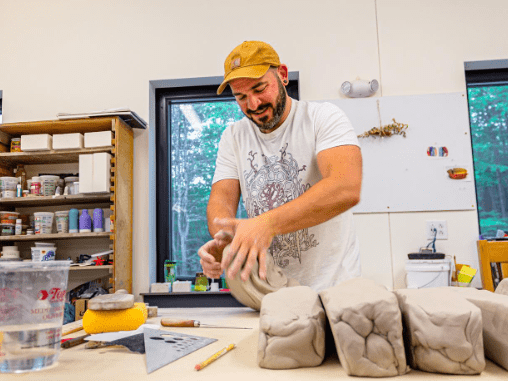
Today we are spotlighting a local Tucson artist, Ibrahim Khazzaka, whose artwork was displayed at Eckstrom-Columbus Library in 2024 and 2025.
He is a Lebanese transnational artist who uses different hand-building and slip-casting ceramic techniques to form sculptures, with vivid colors, and installations that draw the viewer in and reflect on notions of affection, sensuality, and belonging. After a career in clinical psychology, behavioral therapy, and education in Lebanon, Dubai, and Los Angeles, he moved to New York City in 2018 where he switched to focusing on developing his studio practice. In 2023 he earned his MFA from the State University of New York, New Paltz. Ibrahim serves as a public art and grant panelist for the Arizona Commission on the Arts and the Arts Foundation for Tucson and Southern Arizona, committing to advancing cultural equity and community place-making. He has been selected by the national leaders of colors to be Arizona’s representative for 2025. The National Leaders of Color Fellowship (LoCF) is a prominent, 8-month, no-cost virtual program designed to support BIPOC arts leaders in advancing cultural equity, connecting fellows with industry experts and fostering a national network. It focuses on anti-racist, culturally oriented leadership, with alumni collaborating on regional arts initiatives.
Niki
Tell us a little bit about yourself and about your journey from Lebanon to the desert southwest of Tucson, AZ.
Ibrahim
I'm Lebanese born and raised. I studied clinical psychology and worked with people with autism for just over a decade in Lebanon, Dubai and then Los Angeles. Then I had the chance to switch to working in the theme park industry in Los Angeles, through my ex at the time who was a theme park designer. I got to do the whole tour, going to Disney World, Disneyland, Universal Studios, Halloween Horror Nights, 6 Flags…and for someone who’s not born and raised in the U.S., that was a dream come true. Working in theme park production got me into thinking beyond visitor experience to thinking about how different artists come together to design experiences that contribute to culture and meaning making. Then I had the chance to work in Burbank LA, as a production coordinator/ office manager for a Chinese animation production company, which opened another rich world in understanding storytelling and how culturally specific stories can be adapted to a global audience. This is how I got into the arts, mainly through the production coordination line, seeing how ideas go from concept to product/deliverable. In 2018, When I moved to New York I switched to the ceramic field at first through a brief internship, and a work exchange experience at Brickhouse in Queens NY, where Ellen Day was generous and supportive with me, then through ceramic production jobs making a whole range of dinnerware at the high pace Jono Pandolfi Designs studio in Union City, New Jersey and later on making fine porcelain vessels, lighting, prints for the KleinReid studio in Greenpoint, Brooklyn. I owe my work ethics to these two studios and I am forever grateful for the Jono Pandolfi , David Reid and James Klein’s mentorship and friendship .
You can say that I had a bit of an unconventional non academic path into the arts, One path through studio management and the other through production work.
At the same time In NYC after being at Brickhouse for my work exchange, I had the chance to work at 92 Y a Manhattan based world-class cultural and community center where I was the studio manager (2019 - 2021) at their ceramic studio working under director. Bobby Silverman. I learned a lot from him and about community centers and their cultures. Community centers are not places I grew up with in Lebanon.
Then I decided to further my career by earning a Masters in Fine Arts in ceramics and I got accepted at SUNY, New Paltz (2021-2023) where I refined my glazing and firing techniques and negotiated different concepts into installations. After graduation I moved to Edgecomb Maine where I was the studio manager assistant at Watershed Center for Ceramic Arts (Spring/Summer 2023) before finally going on a 3 months Euro tour to study art, architecture and ceramics and focusing on cross cultural dialogue in art and design.
In January 2024 I visited Arizona for 5 weeks. I fell in love with Tucson for everything it has to offer, especially the warmth and nature’s beauty and decided to move here that March.
Niki
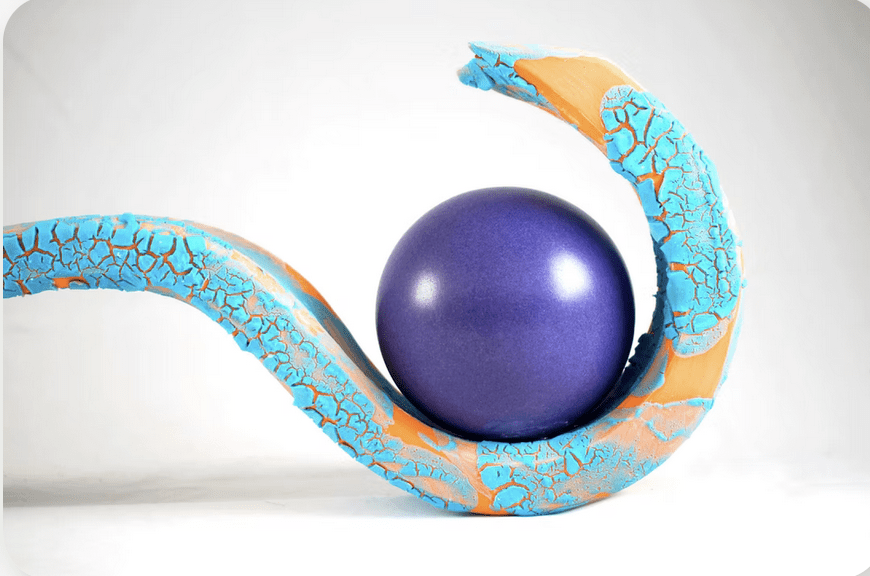
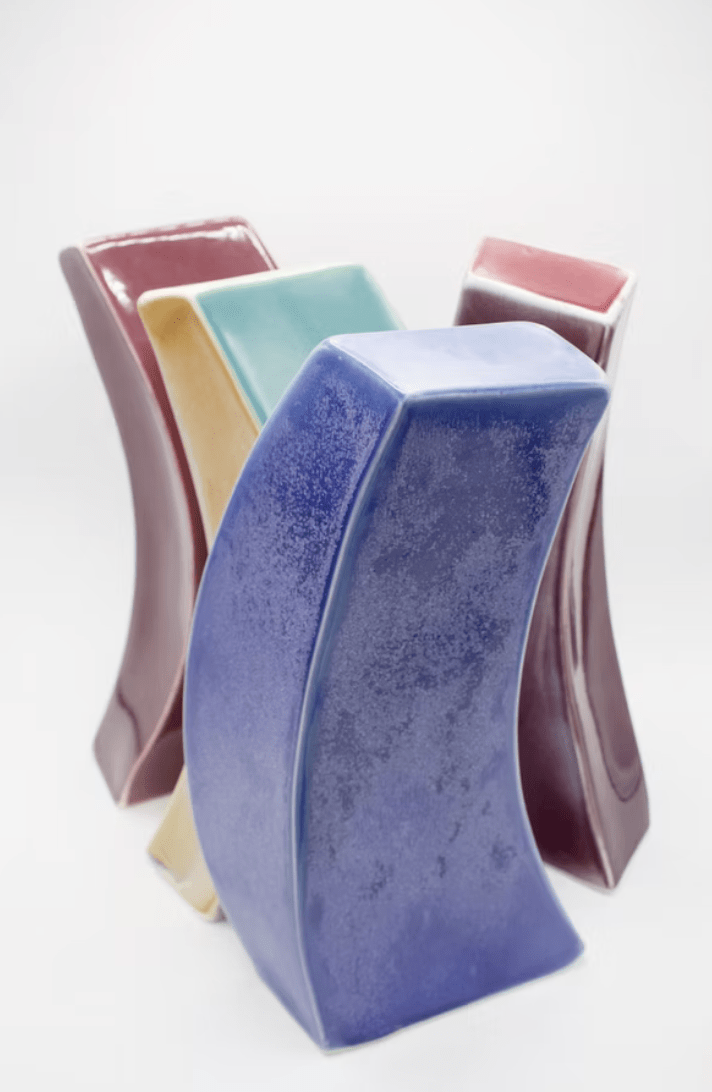
Your ceramic pieces have bold, curved shapes. and vivid colors. Can you share with us your artistic and creative process?
Ibrahim
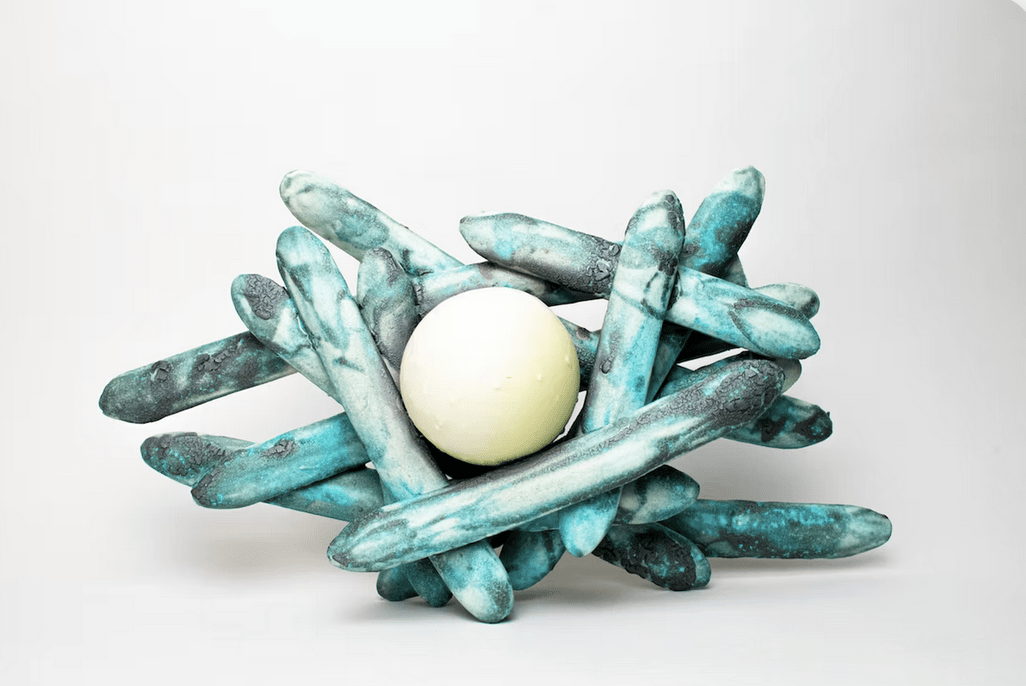
I’ll do my best at explaining this since it is also how I try to explain my process to my students. I'm a ceramic artist mainly. We all start with a lump of clay that can become anything. Everyone is familiar with that first ashtray that we make when we take our first throwing class, but that lump of clay can also become a teapot, a tile or a sculpture. Before going to grad school in 2021, I was focusing on more design production work, thinking of cups, for example, their handles and the subtle design choices that we pour into them, that makes our piece functional and special. My choice of using bold colors came just before COVID hit NYC, in 2019. Every year I have a resolution and one of the resolutions for 2019 was to have more colors in my life from then on, to wear more colors and to put more colors out in the world. So I wanted to experiment with that, to study colors, and how they interact with each other. That’s why I keep my sculptures simple, so they can carry multiple colors in order to create certain feelings and a certain mood.
When I first entered the ceramic field, I was a little bit intimidated by how vast it is, remember, that lump of clay can become anything. I was intimidated also because I didn't come from an art background and I didn’t have anyone who encouraged me to go into the arts. I began focusing on studying composition in sculpture and paintings. For example, I think of unity and density, when I experience art, how elements come together and how some branch out. I also think of curves and how they lead our eyes to follow them. All of this got me to be more interested in the psychology of design and perception.
With practice I became more confident with a medium that’s new to me and I started experimenting with all of its facets. People were very kind, supportive and encouraging everywhere I worked. It’s crucial to have a solid support system while working in the arts.
I kept on making more pieces – sometimes I liked what I was making, and sometimes I didn't. But I learned from every piece I made, and from other designers/artists.
This is how we grow, by constantly learning and revising.
Talya
What emotions do you hope people experience when they see your work? What message are you trying to send through your art?
Ibrahim
The first thing which is very important to me is for people to take their time and take in those colors with a sense of wonder. The strategy is to use these bold colors to attract people's attention, but then for people to keep on looking at things and make out of them what they want to make. Organic things give us the reassurance that not everything has to be measured or dictated - although there are still measured calculated designs that go into most organic made shapes.
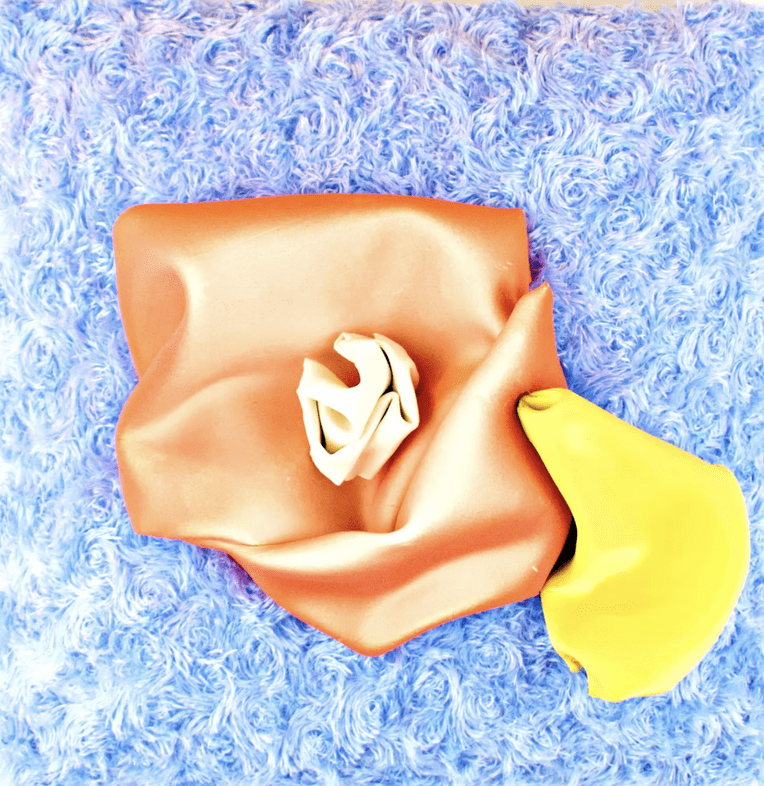
I want people to also remember things that they grew up with, like textile and how comforting its fuzziness can be. If the sculpture is abstract, i want the sculpture to be pleasurable to look at and live with.
Niki
Were there any specific artists who have influenced your art or your process?
Ibrahim
Yeah, when you go to grad school for arts, you take after your professors.
I am very grateful to my grad school professors. One of them was Prof. Brian Czibesz, who is well respected in the field for 3D printing ceramics, and for me, really his iterative approach to design and experimentation inspire me to thinking of the maker’s agency throughout ceramics’ elaborate process but also agency in culture making and even good citizenship. Prof. Anat Shiftan taught me material study rigor and urged me to refine my concepts and forms and to bring forward what I have to offer as a Lebanese artist, she appreciated a philosophical and lyrical approach, which I am familiar with coming from a culturally rich background. In grad school i was able to explore very real topics that we experience in our world, external and internal. Both made sure to give me their best even while COVID was still fresh. And my thesis “At the Gate of Dawn” what I made out of mentoring with both of them.
Then at Watershed Center for the Ceramic Arts that spring/summer 2023, I met more than 90 amazing ceramic artists. I took that opportunity on the spot and I was very excited that I get to work with all kinds of artists from all walks of life. Many of them I always admired and were kind and supportive. Their work keeps on inspiring me till this day and some became good friends who keep on expanding my horizons.
Niki
It doesn’t seem as though ceramics is as spotlighted as much as other mediums. It’s great to see more representation in a diverse medium. How did you get involved in the art scene here in Tucson?
Ibrahim
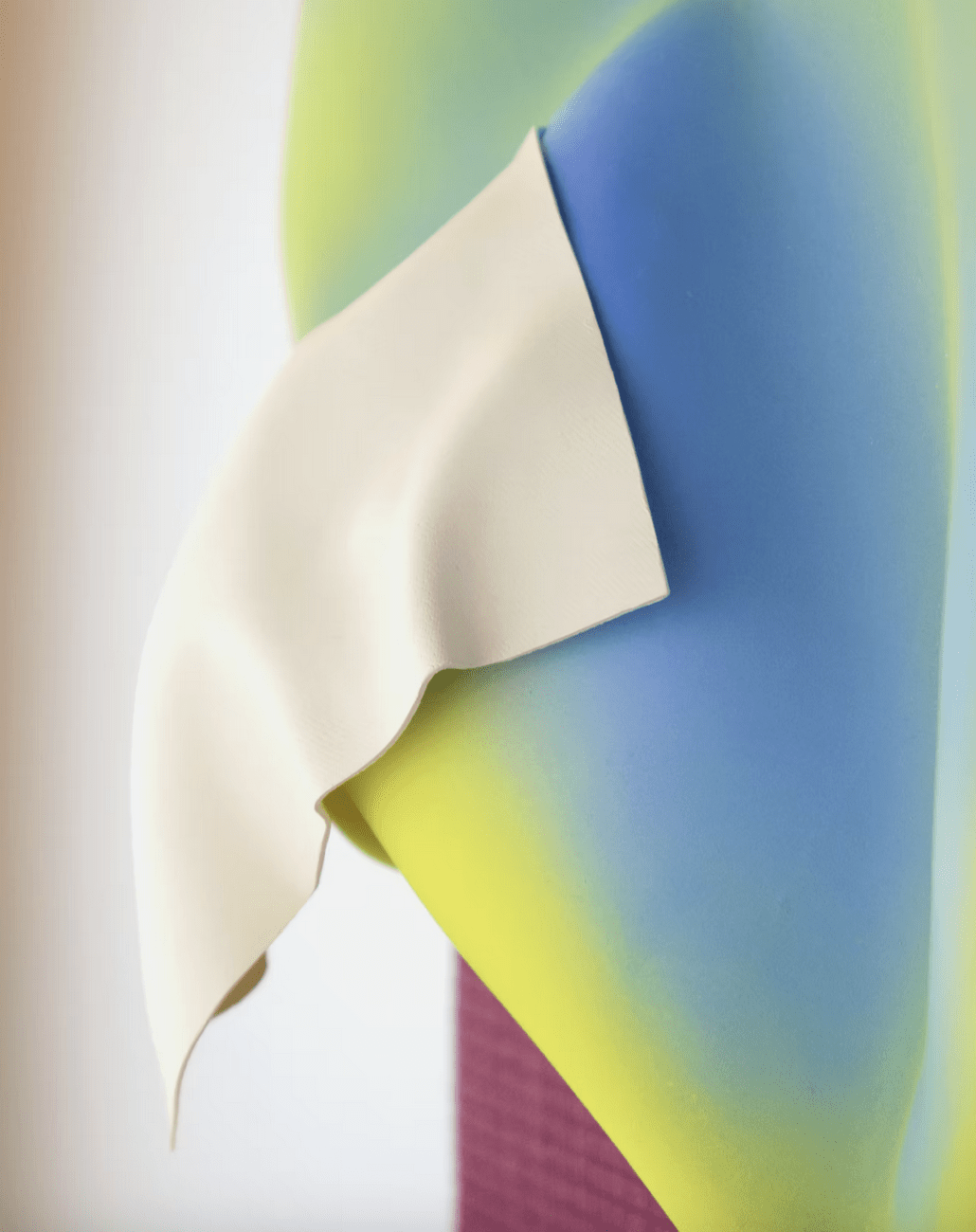
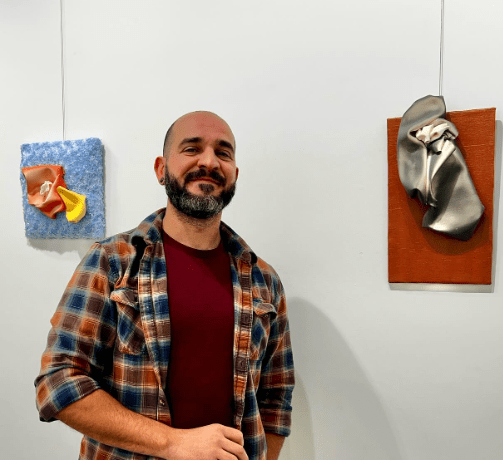
About the medium, ceramics has been seen as secondary to other materials used in the art world and is historically, relatively newly adopted by studio ceramists. Though clay and ceramic work is very versatile. You can put a full bodied or 3 dimensional in the middle as an object or as an installation or you can get a ceramic body of work to hangs on the wall, going from flat, through textured low relief tiles, to higher reliefs reaching out of the wall. That is what I made for the Pima County Public Library, my last body of work was a closer to 2D pieces to hang at Eckstrom-Columbus Library.
Moving to Tucson was an unexpected adventure. In 2023-2024 I went to Europe to connect with museums, historical factories and cultural institutions related to ceramics.
Then I went back to the States and I thought, “OK, what am I gonna do?”
And there was an opportunity to explore Arizona and in particular Tucson, after spending 5 weeks, I drove from New York to Tucson, It took me 38 hours in a little Honda Fit with the ceramic kiln in the back. The Honda was almost touching the road actually! But I made it safely and hit the art scene ground running. Being part of the art world in Tucson has been amazing for me because I experienced even more peer support and more access to city and state wide art opportunities. I started teaching at Pima Community College to teach Art 100 ( Basic Art) and Art 105 (Art Appreciation) classes to non art majors as an adjunct instructor. Then I connected with different organizations there like SAACA (Southern Arizona Arts & Cultural Alliance) which is now Art State Arizona. I connected with Arts Foundation for Tucson and Southern Arizona, and they gave me a grant to further my community engagement workshops. I hosted open studios days when I was a resident at CATALYST at the Tucson Mall for three months in October through December of 2024. Since I got the Creative West leader of color in the arts fellowship, I've been proactive in connecting with artists because I really wanted to understand what they're producing and what they are going through, what their concerns are, what inspires them and what to learn from everyone about their vision for the art scene in Tucson.
Niki
Are you working on anything currently?
Ibrahim
Yeah, absolutely. Arizona Commissions for the Arts is a big organization in Arizona that takes care of its artists. I got an artist development grant, so I was able to get a 3D printer to make models and molds. Until I get access to a kiln again, I'm focusing on researching and designing architectural tiles right now after being inspired by tiles in Spain’s Andalusia, a place with summers as hot as Tucson’s.
I'm trying to connect also to my heritage in Lebanon and seeing what could be cultural items and artifacts that I want to move forward with from their traditional uses into a contemporary body of work. And of course, it's going to have bold colors!
Niki
Where can we view and interact with that when you're finished?
Ibrahim
I don’t have any show that’s confirmed yet but stay tuned I'll be posting updates on my website and then hopefully towards the end of the year I will exhibit some new work in Tucson.
Niki
What advice would you give to young artists who want to pursue art as a career?
Ibrahim
I would highly encourage people to apprentice with an established artist or designer, because they would teach you every aspect of the arts business. If you want to be a product designer or a ceramic studio artist, apprenticing with someone who is established and experienced is crucial. Besides acquiring and refining technical skills, they can pave the way for you to figure out your own market and enter that market with more confidence.
Make sure you have a preliminary business plan in mind. You will reconfigure it as you go. If you're studying art, from the very first day, you're building a portfolio for when you graduate to present to granting entities or a potential mentor/employer. Think of every step with the work ethics that you admire, it’s not always going to be fun and games.
When it comes to making money in the arts, be organized, follow deadlines and build a professional reputation like in any other business. Making meaning, reflecting on culture and seeing work/sculpture/object/installation through is demanding.
There has to be many trials and errors especially in a technically demanding and honest medium such as ceramics, but there is confidence and independence you will gain that you’ll have as a result.
Take your inspiration and rest seriously, some of our best creative breakthroughs come to us when we least expect it . Keep a creative diary on you, jot down techniques, ideas, that one elusive color that you bumped into or that one funny thing that a witty stranger said.
Talya
I want to ask you about your decision in transitioning from psychology to art. Was it easy to choose this medium? How did the decision to make a career transition come to you?
Ibrahim
Coming from any culture shapes the traditions, the norms and values of that culture. For a man coming from Lebanon, society expects me not to be in fields like art.
They expect us to grow into the usual roles that we in the diaspora joke about: a lawyer, an engineer or a doctor.
I had to go against that current when i decide to switch into the arts. Being in the United States for almost 12 years now freed me in that I can do my own thing, own my mistakes and my victories and be proud of them. When I was working with kids with autism, towards the end I was burned out and decided that I wanted to switch careers away from behavioral therapy. Back then, I wanted to work in the humanitarian field, I interviewed some employees at big NGO’s in NYC, and I didn’t like the corporate aspect of working in that field. It was then when I thought I could learn a lot from an internship in ceramics and see how that goes, since I've always loved making things with my hands. Looking back, I am not sure if it was a bold or a reckless move to pivot into the arts in NYC, but one opportunity lead to another with many people’s support.
Something that I enjoy in the arts that still deals with psychology is when I am standing in one corner of an exhibition or a museum and noticing how people interact with the art work, I enjoy that experience as much as I enjoy making and experiencing art, so the psychologist is still there.
Niki
Where can we currently view your art in Tucson?
Ibrahim
At CATALYST at the Tucson Mall. They have two big pieces there from my thesis show, they are wooden panels with a distorted arabesque motif in Kevin Larkin’s custody (CATALYST manager and talented musician who has been one of my biggest supporters in Tucson). I have some 4 inch and 6 inch spheres that I made with different glazes that I formulated. Some are in glaze-luster glazes too. The technique was from 14th century Iraq, and it appeared and disappeared throughout history for different reasons. In-glaze luster is kind of resurfacing since the pandemic too, so some of those examples are at CATALYST. For the time being that is what I have until I exhibit more in Tucson, which I'm looking forward to.
Niki
Are there any books that you are currently reading or that you would recommend?
Ibrahim
First, i want to say that I love the library system in the U.S. I'm a huge fan. I'm there every week and I do check out seeds from the seed library! Thank you for that program! I'm also a huge fan of the digital platforms like Hoopla and Kanopy too and I keep on telling my students to sign up and take advantage of those services. I'm currently reading a book called Collaborative Intelligence: Thinking with People Who Think Differently by Dawna Markova and Angie McArthur. I'm very interested in the topic of intercultural dialogue and how two people can come together and work towards authoring and building a shared vision, also I am always thinking about what an ethical collaboration between two people might look like. There is a book that I really enjoyed called Collecting Objects / Excluding People: Chinese Subjects and American Visual Culture, 1830–1900 by Lenore Metrick-Chen which explores how 19th-century American art and media created contradictory views of "Chineseness" to simultaneously admire Chinese objects while excluding Chinese immigrants. It argues that this imagery shaped both American modernism and immigration policy. And then I would share also a book called Dancing with the Gods: Reflections on Life and Art by Kent Nerburn. Which has been very motivating. I also am often checking out of the library’s digital shelf the magazine “Ceramics Art and Perception”, they keep my knowledge of the field fresh.
Talya
What role do you think public art plays in the community, especially in the library and cultural spaces?
Ibrahim
At Pima Community College, I send my students out to review public art, and art in public spaces. Tucson is very rich in public art and I'm currently sitting on a public art review panel with the Arts Foundation for Tucson and Southern Arizona.
Access to culture is very important. Most of us are intimidated by museums or gallery spaces. Some of those spaces are made to make us feel a little bit inadequate and awkward, so public spaces are very important in allowing people into that conversation and interaction with art.
The Public Library is doing an amazing job because people use it not only to borrow books, but for all kinds of rich programs. People use the library to look for work, access services, language and citizenship classes… or to sit there and enjoy a quiet afternoon at a safe space as well. And it's intriguing to have a piece of art on the wall to look at and enjoy and appreciate. I like that the public library rotates the art and that is why I exhibited with the library twice already. I will do it as long as you give me a space.
Niki
Is there anything else you wanted to say or comment on about your experience, your art, or your journey?
Ibrahim
Yeah, I would say be true to and honest with yourself as an artist.
Again, it's a consuming full-time job.
Some people are going to surprise you with their help and their generosity. Some are watching over you and want to see you succeed, without you knowing. Just make sure you do the work and share it with the world.
Also don’t be afraid to reach out to people. The worse you can get is a “No.” When you get a “No”, follow up with an e-mail and ask for feedback, let them know in a way that you want to improve and be receptive to their feedback. From my experience, most people will be happy to give you constructive criticism. Criticism is an act of generosity, don’t take it for granted when you ask for it and when you receive it. This is coming from a tried and true approach.
Last but not least, show up not only for yourself, but genuinely show up for your community.
Talya
Do you have any favorite public art in Tucson or public art in the world that you recommend people to travel and go see?
Ibrahim
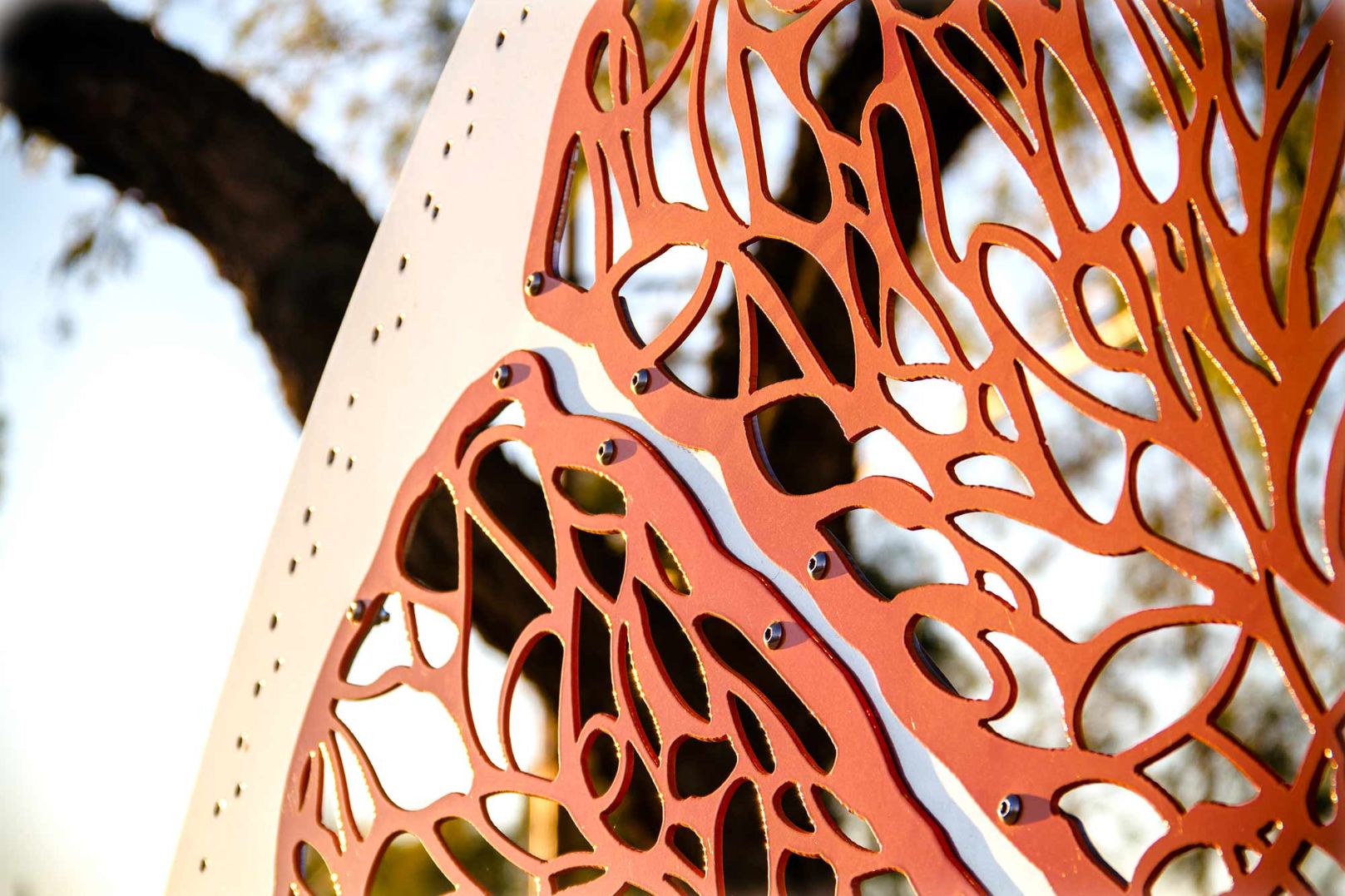
There are so many in Tucson! I love the murals around downtown. Ignacio’s murals are fascinating and Joe Pagac's murals are amazing because they give a sense of Tucson. There is a nest sculpture in front of the YMCA on the north side made out of bronze twigs that I really love and it makes me feel held.
I'm always going to love the colorful things. There are “Tock1, Tock2, Tock3” by Carrie Seid, Which are one large full orange slice and 2 half orange slice benches on Orange Grove (Address: W Orange Grove Rd.: N. Shannon Rd. to Mona Lisa Rd.) that look amazing against the landscape and more so basking in a warm sunset. When a pedestrian sits in the middle of the bench usually around sunset, it looks like they have a peacock orange slice open tail which always makes me happy to see.
Niki
Thank you for sharing those. We really appreciate your time with us and we know how precious your time is since you're currently in Beirut, Lebanon.
We want to wish you safe passage when you come back to Tucson and we are looking forward to the art that you'll be creating so that we can stand in front of the pieces and have our expressions while you observe us from afar!
Ibrahim
I'm very antsy to go back to Tucson for the past few months. It's been good visiting Lebanon. I came back for family, and it's been good reconnecting with them after 14 years but Tucson is very nourishing and people are kind and I'm making a lot of friends along the way.
Thank you for having me, it’s an honor talking to both of you and sharing my artistic journey.
