
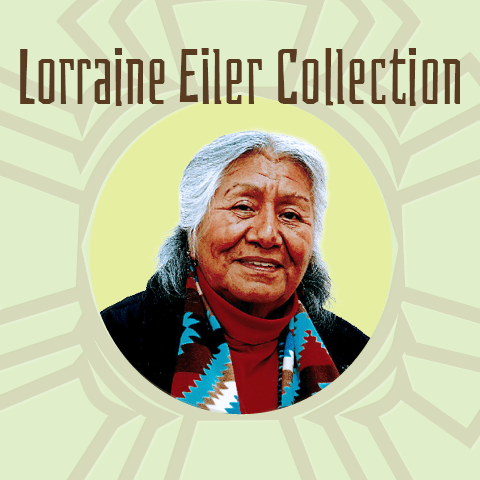
In January 2026, we celebrated the release of the Lorraine Eiler Special Collection at Salazar-Ajo Library. At the event, Lindsey Curley—librarian in the Community Engagement Office and member of the Many Nations Team—shared her connection to the collection and its importance to the community.
Yá’át’ééh shí éí Lindsey Curley yíníshyé’.
Kinłichiiʼnii nishłį́.
‘Oozei Áshįįhi bá shíshchíín.
Hashk’aa Hadzohí dashicheii.
Ta’neeszahnii dashinálí.
Hello, my name is Lindsey Curley.
I am Red House Clan, and I am born for the Hopi Salt Clan.
My maternal grandfather’s clan is Yucca Fruit Clan.
My paternal grandfather’s clan is the Tangle People.
Amongst new faces, I usually take the time to introduce myself in Diné Bizaad. It is a way that the Holy People and my ancestors can identify me on this Earth, in almost a geographical way, a call for them to be present here on this wonderful evening, to honor Miss Lorraine Eiler and her collection at the Salazar-Ajo Library in the Pima County Public Library system. I am proud to speak on behalf of the work I did for this collection when I was a graduate assistant.
PCPL has a beautiful connection and partnership with the Knowledge River Scholars Program, which specializes in educating library and information professionals through professional development and practical experience. As Knowledge River Scholars, we were exposed to much practicality, theory and worldviews from the Western Scientific Tradition responsible for how information is standardized through Libraries, Archives and Museums. We, being made up of primarily BIPOC information practitioners, learned quickly that the field of Library and Information Science ebbs and flows heavily on mainstream consciousness. Ultimately, it left many of us Scholars asserting self-determination practices, talking about the importance of cultural consultations and advocating for communities who were deemed a niche, esoteric or an ethnographic account of humanity and its formation in a dominant society. In classrooms, I believe that we pushed that collective mindset because we already knew that our generational wealth didn’t only rely on what was written in books, our wealth also included those oral accounts, those songs and those ceremonies that told us who we are as people and gave us meaning to our existence in the larger landscape of the world. I am proud to say that many of us who have gone through the Knowledge River Program are here with us today as a part of the Pima County Public Library community, especially in leadership positions.
When this project fell under my facilitation and responsibility, former Assistant Manager of the Library's Technical Services Department and legend, Diane Ward, helped me to understand the technical processes of how cataloging information could ultimately influence how bodies of knowledge enter the mainstream consciousness. While I went to school in Tucson, I received deliveries of Miss Eiler’s books two-three weeks apart from the Ajo Library. I had the privilege of holding each book, reviewing them for their historical information to their poetical representation about Indigenous peoples and their connection to the Sonoran Desert. As a poetry enthusiast, my heart always looked forward to reading her poetry books, and at times seeing the initial pages signed and addressed by notable Indigenous poets to Lorraine herself. Relying heavily on my own understanding of regional based knowledge systems to catalog and return Miss Eiler’s collection to the Ajo area, I already knew how important the cultural cosmologies contained within these books are more powerful when they are made accessible to its original stakeholders, the Hia-Ced O’odham and the Tohono O’odham people.
Wanting to also ebb and flow heavily on Indigenous Knowledge Systems to provide longevity and cultural resonance for this collection, I navigated Western cataloging standards to address its inadequacies that labels O’odham peoples as “Papago,” a derogatory term applied by Spanish colonists upon first contact. Because The Tohono O’odham Nation adopted their traditional name in 1986, I knew that the work in cataloging Miss Eiler’s collection was a facet in exercising Tribal Sovereignty on behalf of my fellow neighbors, in the hopes that perhaps one day Hia-Ced Peoples gain federal recognition from the work performed here.
Having brought these complexities to my superiors, I was encouraged to speak with the Library of Congress where my grievances were understood. I provided more accurate language codes and tailored MARC records to all materials in Miss Eiler’s collection where on the backend of PCPL records, us as a public library system could silently, yet tactfully, set a standard and encourage all library systems nationwide to adopt our methodology on O’odham written materials. It ended up being a beautiful display of allyship and solidarity for our Indigenous community members. When I finally finished cataloging, I was filled with great joy and encouragement to continue this kind of work beyond the collection knowing that cultural authenticity and cultural representation were values that even my non-Indigenous colleagues could share with me. A part of why I often say “Library Practitioner” is because of what I have witnessed and observed as medicinal to the practice of information when it concerns a community and their autonomy. Yes, libraries have the ability to heal in this way, too.
In the Spring of 2023, I completed the collection and graduated with my master's in Library and Information Science at the University of Arizona. Since that time, I always carried the work from Miss Eiler’s collection with me. It informed the way I navigate a discipline born out of Western Science to amplify Indigenous voices, as well as elevate my approaches in customer services and resource equity. I only knew how the journey of cataloging this collection meant to me, but I didn’t anticipate how that process would ultimately exercise a facet of truth and reconciliation for Indigenous communities. It has been a long time coming, a celebration for Miss Loraine Eiler, and I am just very happy to have been included to speak on behalf of her generous gift to PCPL and Ajo’s surrounding community.
