
This blog post is by Samantha N., Latinx Services Librarian.
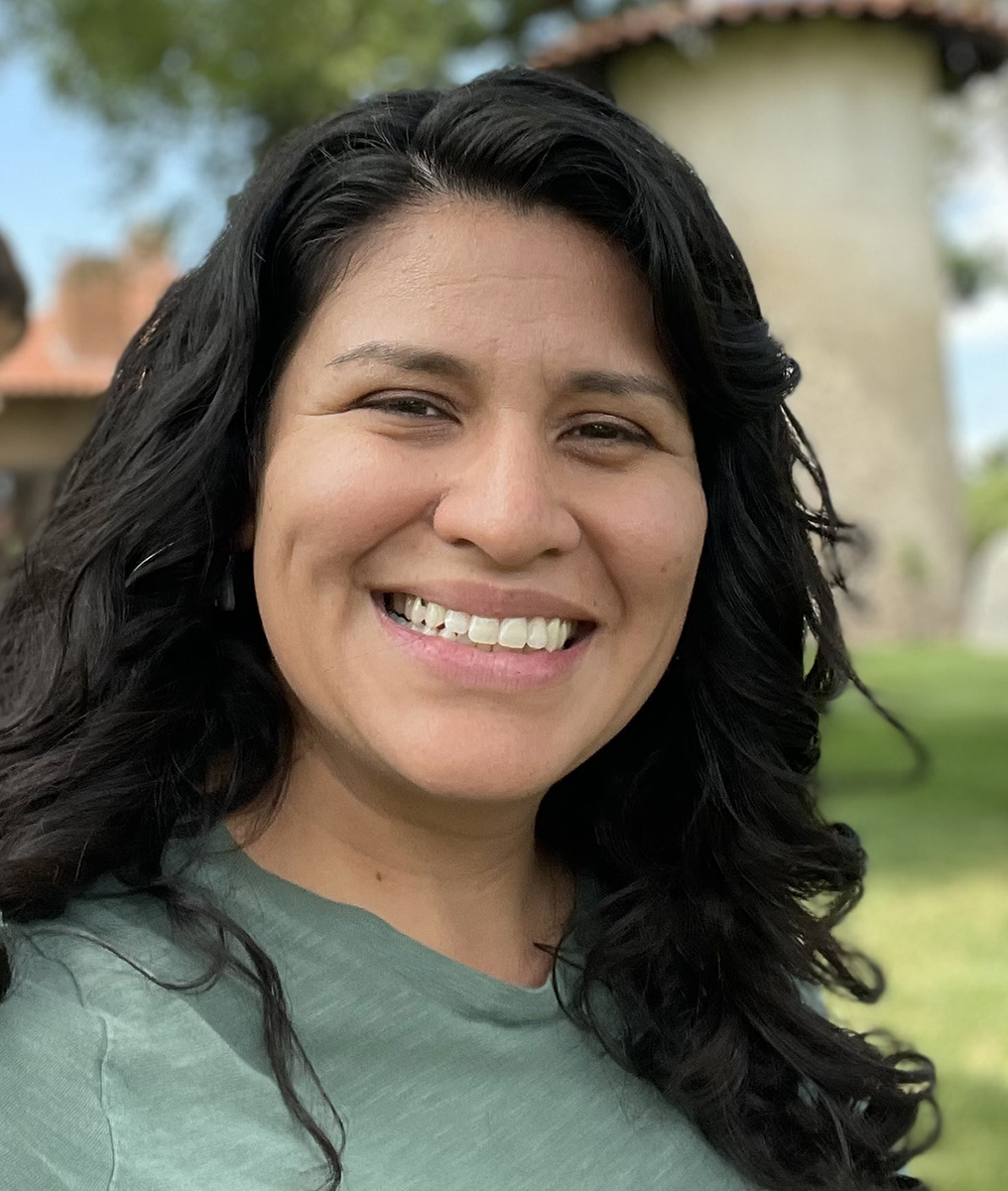
On December 13 a memorial for those impacted by TCE pollution was unveiled in Mission Manor Park (scroll down to see photos from the event). The tile mural memorial was created by the community through workshops facilitated by artist Alex! Jimenez, who also spearheaded the design of the memorial. According to her Instagram, Alex! Jimenez is a fourth-generation Tucsonense, mother, illustrator, printmaker, artist, and desert lover. She is the author and artist behind the Seek & Find Alphabet Book, worked as an artist-In-residence for Tucson Water during which time she helped create Chubasco Channel: A Monsoon Soundscape, and later she led the community in the creation of “In Memory Of,” a public art project to honor those who died of COVID-19.
I, as a member of the Nuestras Raíces Team, spoke with Alex! about their art, their career, Tucson, and more. Below is some of what Alex! shared:
Tell us a little bit about your journey to becoming an artist.
I didn’t start out in art. I was a scientist first. I wanted to become a veterinarian. I got a scholarship to Cornell University in upstate New York, and yeah, I went there and got a degree in animal sciences. But about midway through I just realized the science field wasn’t for my personality... And eventually [after graduating], after a few years back in Tucson, I realized that I wanted to try to be creative, so I went back to the U of A. At first, I was going to do graphic design but then I found illustration and the illustration field is really cool because you don’t need to be a certain style, you can find your own voice as an illustrator and be successful. Right out of college I applied for a grant to do a project, Abecedario del Sur, my alphabet project... My alphabet book was actually a college project. It was a typography project to find the alphabet wherever and I went to the south side where I grew up and took pictures of all the buildings and small businesses that had hand-painted signs. It was a geographic alphabet book. I designed it so that you looked at the book flipping North to South, not A to Z. So, the first book was actually a North to South drive from central Tucson, downtown, into the south side. I was really interested in the change that happens. Since I grew up on the south side I was very aware of the visual difference between where I grew up and the rest of Tucson and so the book was all about the street culture and the visual culture of the south side and the community of people who have had successful lives here in the south side of Tucson, which has always been very underrated. At least when I was growing up it was the ghetto side of town. So then that grant launched me in making art and, over time, I have gathered different mediums along the way.
What is the visual difference between the area where you grew up and the rest of Tucson?
The south side of Tucson has a lot of mom-and-pop businesses. Because of all of the Mexican immigrants in the south side community, a lot of the aesthetic came from Mexico. People reproduce what they're familiar with. In Mexico, there’s a history of sign-painting, and they have people called rotuleros who paint signs. People advertised by hiring a rotulero. So, the visual aesthetic of signage in Mexico is pretty distinct, and that aesthetic, well, that trade, was brought over from people who came over. Every time I went to a business, I’d ask them who did their sign, and it was always just someone they knew. It’s enough of a language that it feels cohesive when you drive down South 6th or South 12th Avenue. You can tell that this is like a different, distinct community, and it feels like parts of Mexico. I was really interested in that difference between a heavily planned streetscape, like downtown Tucson has become, versus a more wholistic, visual aesthetic that arrives from the community that lives there.
What drew you to create a tile mural to honor those impacted by TCE pollution?


I was drawn into the project because of the work that the Mexican American Heritage Museum had been doing. They wanted to do a retrospective of how it’s been 40 years since the journalist Jane Kay exposed the water contamination. And prior to that there had been a pretty organic community and environmental justice movement—Tucsonans For a Clean Environment. They were neighbors who were concerned with all the health issues that they were seeing and they started going door to door, kind of taking surveys of how people were being affected and trying to gather their own evidence for what they were seeing happening to their community. Alisha Vasquez of the Mexican American Heritage Museum pulled me in and asked me to do an artistic component to the work that they’re doing, and I tend to do public art that’s community driven, so participatory art-making. I told her that we can do a similar project to what I had done for the COVID memorial, but this time, I wanted to also to have some of the visual control to make it a little more a mural that I’ve made with components from the public.
When I had built the memorial for people who died of COVID, over at Mission Manor Park, I had always wanted to put something over on the back side of that wall that I built, and I wanted it to be about the TCE contamination. I had already done a lot of work around water as an artist, so Alisha, naturally, reached out to me. Also, I’m from the south side, so she knew it was my community, and my mom died of cancer at 52, and she was probably exposed to the south side water for about one to two years. I still don’t know whether I could conclusively say anyone in my family was directly affected, but I see health problems within my family that are consistent with what other people in the south side have experienced, like infertility, and then my mom getting this aggressive type of cancer. So, after she died is when I kind of actually heard of about the whole history of the contamination. I didn’t know anything about it.
Why did you choose to make the memorial a collaborative project?
My art practice is very grounded. It’s very based in my lived experience as a Chicana in Tucson and so naturally my public art is an extension of that and when I’m making art in a community, it’s important to me that the community is represented in some way, because that’s the type of work I do. I’m a storyteller as well as an artist. Art is storytelling. I had done workshops before for my prior project and I liked how it made people feel, and how I was able to include hand-made elements from the community in the final product. So, I wanted to do the same again for this project.
Were there any stories or conversations shared in the workshops that surprised you? Or that you learned from?
I heard echoes of similar sentiments from people who believe that their illnesses were caused by the contamination. We had a few people who knew their family was exposed, but were never involved in the lawsuit, because they couldn’t prove it, and then just a general need that people have in the community for their experience of harm to be acknowledged, and that it felt really good to participants to be able to not only make something about their experience but also to know that it was going to be a publicly recognized thing. Because a lot of people didn’t die, they have just lived with long-term illness because of the exposure, and that’s not easy to go through. But I think one interesting thing that I didn’t really know that much about until working on this project was just the extent of the community activism that went into exposing the contamination. It’s really inspiring that these neighbors did this work and it’s very indicative of the Mexican community and how in the south side people look out for each other. Back then, it was just through sort of sharing oh, so and so is sick, and oh, this other person is sick, that sort of grapevine, you know, the chismoso, being metiche, and sharing things. Connections were made in the community about something bigger going on to people. Happening to them. So, it was really cool to hear more history about that activism, especially in the current climate we’re living in.
You are a fourth-generation Tucsonan. Tell us about the history of your family in Tucson.
My Nanita*, her maiden name was Leyva. The Leyva family came over in the early 1900s, during the Mexican Revolution. So, my family was kind of, of that wave of immigrants that came when the fighting was happening, and my great-great-great grandfather, her father, he went back to fight, and never came back, but he left his wife and nine kids in Tucson. And my Nanita, Trinidad, she was the oldest of the nine. They lived in El Hoyo, which is where the TCC is now, and they were displaced from that area during urban renewal. I believe she [My Nanita] had moved out of that area already, but I think she might have had elders that were living there too. And so, my Nanita... well, she met a man and they eloped, and they moved to Barrio Blue Moon, which is over at Speedway and Main. So, I grew up going to that house a lot. My Nana grew up in that neighborhood, and walked to Tucson High, and went to Davis, and so my family was very much part of the community of many Mexicans who lived in the downtown area back in the 50s. And then my Nana married my Tata, James Orosco, but his family is from New Mexico. And his father, my great-grandfather, James Orosco, worked in the mines. Mining is a big part of the Mexican community in Tucson as well. He bought a house in the south side of Tucson because he worked in the mines in Green Valley, and there’s a lot of his generation of Mexican-Americans who worked in the mines down there.
My family is very much a part of the Mexican-American history in the downtown area of Tucson. Coming from El Hoyo and then moving to the south side is a very common narrative, and something my family did too, and then my parents, when they moved out of the south side, they moved to the southwest, which is also true of a lot of the next generation, of my mom’s generation, [that] was able to afford homes in the southwest across the river. So that branch, the Leyva Robles branch of my family, the maternal side, is the one that’s been in Tucson the longest.
*Alex’s Nanita is her great-grandmother.
Are there any stories that they shared with you?
Barrio Blue Moon is called that now because there was a night club, the Blue Moon Night Club, and it was open when my Nana was growing up and her father was very protective of the girls, of his daughters, and he would never, never let her go there. She wasn’t allowed to go dancing there, but was part of a social club in high school, I forget their name, but there was a group of girls and my Tata was in another social club which was a group of boys, and they met at a dance. And they would dance at different places, but they had dances at Casino Ballroom, so my Nana would go there when she was young. As an immigrant in Tucson when she was growing up, Tucson was still segregated. So, my Nana grew up with segregation as being normal. And I asked her, weren’t you upset, didn’t it feel bad? And she said she didn’t notice. She just had a happy childhood. Part of that was because of how insulated and close the Mexican-American community was. They created joy for themselves, through dancing, and social clubs, and all of that.
What do you love about Tucson? Have there been notable changes over the years?
I love Tucson mainly because of the feeling of belonging that I have as a native to Tucson and then as someone whose family has been here a long time, and I also love that Tucson is surrounded by beauty, you know, the mountains in every direction, and that you can go from the Sonoran desert to high-altitude grasslands, then up to a pine forest, within the span of an hour. And you can drive an hour in either direction and find another interesting ecosystem—the San Pedro River Basin, the Organ Pipe National Forest. We’re just centered to so much natural beauty. And the changes are just I think too much urban sprawl.
Do you have a favorite artist?
I love all the work that Creative Machine does. They’re an artist slash engineering company that does a lot of public art installations, and because I was a scientist I really appreciate art that’s like a mixture of the sciences and art.
I really like the painting work of Jessica Gonzales. Her stuff is beautiful.
Historically, I really love Rothco as a painter, and Joan Miró. Those were probably my favorites in school. I really admire their use of color and color fields, and then Miró was real abstract but expressive. I also liked his color palette.
I’m really inspired by Mexican folk art.
What advice do you have for aspiring artists of all kinds?
Well, it’s a lot of work. You have to be your own business if you want to be successful. And if you want to be successful, you really do have to learn how to administer, how to be organized, it’s really difficult... I would say, I wish I had had more time to explore and have more fun with my art first, because the work of making your art make money can really suck the life out of art-making because art is my job now. So, I don’t do art for fun. I do art for work. Which is fun, sometimes, but also, it’s a job. Successful artists that I’ve seen have either one really strong focus, or they hustle like crazy like I do and do a lot of different things. I enjoy learning new things, so with every project I learn something new. Two years ago, when I did my COVID memorial, I learned how to do clay. So, this is my second clay project and I only learned how to do clay a couple years ago and I only learned over the course of a year with a fellow artist who had 30 years in the field of ceramics. I learned a lot from her. Other advice, be an assistant on projects. Learn from people, collaborate. You’ll always learn more collaborating and you’ll get more done.
Also, there are a lot of grants out there. That’s the other thing. Get good at writing. Get good at writing about yourself and your art because it’ll help you out tremendously.
Gracias, Alex!
For more information about the TCE memorial and history of activism, visit this link.
Stay connected with Alex! Through their Instagram.
The photos below—documenting the December 13 unveiling—were taken by Hilda Cortez (HCortez Media).


